
Behind the Medical Cover at a Major Stadium Event

Updated: Sep 16
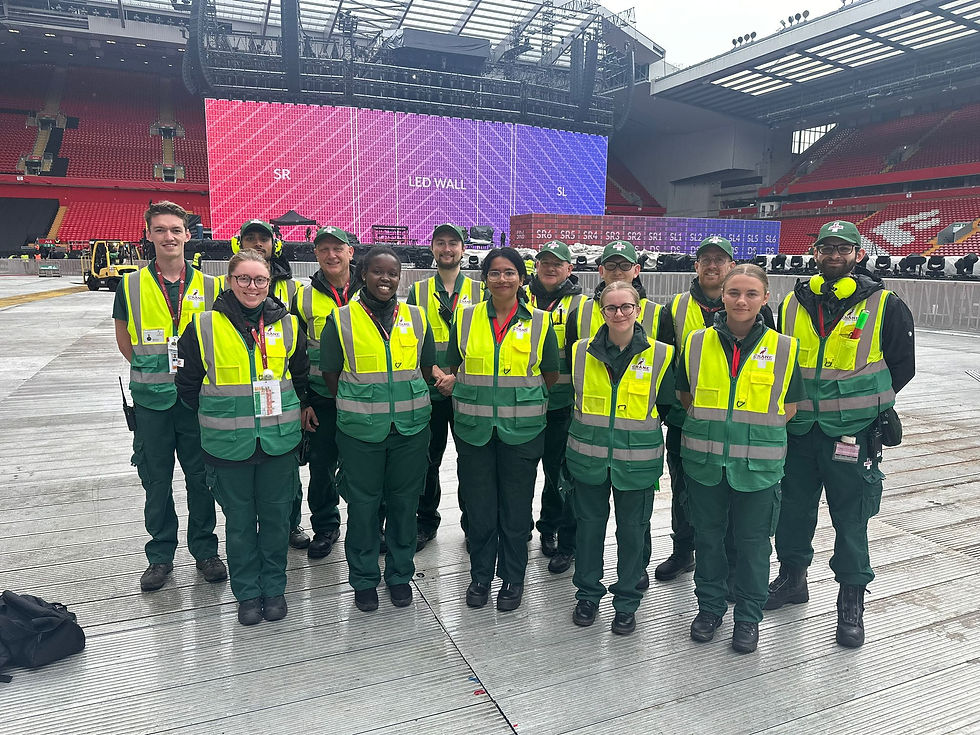
Crane Medical Care medical team providing stadium event cover. Crane Medical Care event medic supporting spectators at a live concert. Crane Medical Care event medical staff member at a stadium event. Crane Medical Care event medics working at a sporting event. Crane Medical Care medic supporting a professional sporting fixture. Crane Medical Care event medical team providing cover at a large stadium event. Crane Medical Care event medical equipment and branding at a stadium.
When thousands of people arrive at a stadium for a football match, concert or major sporting event, most will never see the planning that sits behind the medical provision.
For spectators, the medical team may simply appear to be a visible presence around the venue. In reality, stadium medical cover involves detailed preparation, clear communication, experienced personnel and a coordinated response structure designed to protect spectators, staff, participants and performers throughout the event.
At Crane Medical Care, our teams have supported hundreds of fixtures and major events across professional football, sport and live entertainment. That operational experience shapes how we approach medical cover for large events, from the planning stage through to post-event review.
So what actually happens behind the scenes?
Medical Planning Starts Long Before the Gates Open

Effective sporting event medical cover begins well before spectators enter the venue.
Every event has its own risk profile. A regular league fixture may require a different medical plan from a high-profile derby, cup tie, concert or event with an increased attendance or heightened operational risk.
Planning may consider factors such as:
Expected attendance
Venue capacity and layout
Event type
Audience profile
Previous incident data
Alcohol availability
Weather conditions
Crowd movement
Participant or performer risks
Event timings
Access and egress
Ambulance access
Proximity to local emergency departments
Security and crowd management arrangements
The objective is not simply to decide how many medics should attend. It is to understand where medical resources should be positioned, what level of clinical capability may be required and how the team will respond if an incident occurs.
For major stadium events, that planning needs to integrate with the wider event operation.
Building the Right Medical Team
The medical team needs to reflect the size and risk profile of the event.
Depending on the requirements of the venue, the team may include:
First Aiders
Advanced First Aiders
Emergency Medical Technicians
Paramedics
Other registered healthcare professionals
Medical control personnel
Mobile response teams
Pitch-side or participant medical teams
Different members of the team have different roles, but they all need to operate as part of one coordinated service.
At a large stadium, personnel may be positioned across stands, concourses, treatment areas and other key locations so that patients can be reached quickly.
The right skill mix is particularly important. A minor injury may be managed by a first aider, while a patient experiencing a serious medical emergency may require assessment and treatment from a more senior clinician.
Having clearly defined escalation pathways means the appropriate level of care can be brought to the patient when required.
Positioning Medical Resources Around the Stadium
A major stadium can be a complex environment.
Thousands of spectators may be spread across multiple levels, stands and concourses, while some areas become extremely busy immediately before kick-off, during half-time and when the event finishes.
Medical resources therefore need to be positioned strategically.
This may include:
Static medical posts
Dedicated treatment rooms
Mobile response teams
Pitch-side teams
Ambulance resources
Medical control
Equipment positioned throughout the venue
The aim is to balance coverage across the stadium while maintaining the ability to respond quickly if several incidents happen at the same time.
A patient in an upper concourse, for example, may require a very different response and evacuation plan from someone who becomes unwell close to the pitch.
Good stadium medical cover considers these practical challenges before the event begins.
Medical Control and Communication
Communication is one of the most important parts of any large event medical operation.
At a major stadium event, medical incidents need to be received, prioritised and allocated efficiently.
Medical control may coordinate:
Incoming medical calls
Deployment of response teams
Escalation to clinicians
Requests for additional equipment
Patient movement
Ambulance requirements
Communication with event control
Updates from medical teams
Recording operational information
Radio communication helps ensure teams can be deployed quickly while maintaining situational awareness across the venue.
This becomes particularly important during busy periods or when several incidents are happening simultaneously.
Medical teams must also communicate effectively with other parts of the event operation, including safety, security, stewards, venue management and emergency services.
Responding to Medical Incidents
No two events are exactly the same, and neither are the patients.
During a major stadium event, medical teams may respond to anything from minor injuries through to potentially life-threatening emergencies.
Common presentations can include:
Trips and falls
Cuts and minor wounds
Fainting
Alcohol-related illness
Asthma
Seizures
Chest pain
Allergic reactions
Head injuries
Musculoskeletal injuries
Medical emergencies requiring ambulance transfer
The first priority is always the patient.
Teams assess the situation, provide appropriate treatment and determine whether the person can remain at the event, requires further observation or needs escalation to hospital care.
Having an established medical structure within the venue means many patients can be assessed and treated safely on site while emergency escalation remains available when required.
Supporting the Field of Play
At sporting fixtures, medical provision may also extend to the field of play.
Pitch-side care is a specialist part of sporting event medical cover and requires close coordination with club medical teams.
At professional sporting events, our teams may work alongside doctors, physiotherapists, paramedics and other clinical professionals.
Pitch recovery personnel may support the safe and coordinated removal of an injured player from the field of play, following the direction of the appropriate clinical team.
This requires:
Clear communication
Familiarity with pitch-side procedures
Safe manual handling
Coordinated player extraction
Professionalism in high-pressure situations
While spectators may only see this response for a few moments, significant training and preparation sit behind it.
Preparing for Higher-Risk Fixtures
Some stadium events present additional operational challenges.
High-profile fixtures may involve increased crowd intensity, alcohol consumption, anti-social behaviour or the possibility of disorder.
Medical planning therefore needs to consider not only routine illness and injury but also scenarios where several patients may require support at the same time.
Medical teams may need to work closely with:
Stadium safety teams
Security
Police
Stewarding teams
Event control
Ambulance services
The priority remains safe patient care, but the environment in which that care is delivered can be fast-moving and challenging.
Experienced teams are therefore particularly important.
Crane Medical Care's event personnel have worked across professional football, stadium events, concerts and other major public events, giving our teams practical experience of operating in busy and high-pressure environments.
When an Ambulance Is Required
Most patients seen at an event will not necessarily require hospital treatment.
However, where further assessment or treatment is required, a clear escalation pathway is essential.
Depending on the medical provision in place, this could involve an on-site ambulance resource or requesting assistance from the local NHS ambulance service.
The medical team must provide an effective handover, including relevant information about:
The patient's condition
Observations
Treatment provided
Changes in their presentation
Relevant medical history where available
Safe transfer is part of the wider event medical plan rather than an isolated decision made once an emergency occurs.
Documentation Matters
Medical care at a major event does not end when the patient leaves the treatment area.
Accurate documentation is an important part of clinical governance.
Patient records may document:
Presenting complaint
Assessment findings
Observations
Treatment provided
Advice given
Escalation
Patient outcome
This information supports continuity of care and helps the provider review activity after the event.
Operational data can also identify patterns.
For example, repeated incidents in a particular area of a stadium or an increase in certain presentations may influence planning for future events.
Reviewing the Event Afterwards
Once spectators have left and the venue begins to empty, the medical operation is not necessarily finished.
Post-event review helps identify what went well and where improvements can be made.
Depending on the event, this may involve reviewing:
Patient numbers
Types of incidents
Ambulance transfers
Significant clinical cases
Response times
Resource use
Operational challenges
Incidents or near misses
Feedback from the medical team
This process supports continual improvement and helps ensure future medical plans remain appropriate.
Experience Matters in Stadium Medical Cover
Large events require much more than simply placing first aiders around a venue.
Effective medical cover for large events depends on planning, leadership, communication, appropriate clinical capability and a team that understands how major events operate.
Crane Medical Care has supported more than 100 fixtures across professional sport, including Premier League, UEFA Champions League, FA Cup and professional rugby environments.
That experience helps inform how our teams approach everything from routine spectator care to complex incidents requiring rapid escalation.
Our wider event medical experience also includes stadium events, concerts, festivals and public events, giving our teams an understanding of the different pressures that large-scale environments can present.
Event Medical Cover in Liverpool and Beyond
Crane Medical Care provides professional event medical cover in Liverpool, Merseyside, Wirral, Cheshire, the wider North West and throughout the UK.
Our event medical services can be tailored around the size, location and risk profile of each event, with support available for:
Stadiums
Sporting fixtures
Concerts
Festivals
Community events
Running events
Mass-participation events
Public events
Whether an event requires first aid teams, mobile responders, clinicians, treatment facilities, pitch-side support or a wider medical operation, the planning should always begin with the specific requirements of the event.
Planning a Major Event?
If you are organising a stadium event, sporting fixture, concert, festival or other large public event, the right medical provision should be considered as part of the wider event plan.
Crane Medical Care can work with event organisers, venues and operational teams to develop a medical provision that reflects the needs of the event and the people attending.

Comments